
Title: Three Hearts, Blue Blood, and Alien Intelligence: Why the Octopus is Nature’s Masterpiece
Slug: why-octopus-is-special-nature-creation
Meta Description: Explore the astonishing biology of the octopus: 3 hearts, blue copper-based blood, instant camouflage, and a distributed brain. Discover how this alien-like genius of the sea compares to us humans.
Focus Keyphrase: octopus special characteristics
Categories: Marine Biology, Nature & Wildlife, Amazing Animals
Tags: octopus facts, animal intelligence, comparative biology, marine life, nature wonders, cephalopod science
Three Hearts, Blue Blood, and Alien Intelligence: Why the Octopus is Nature’s Masterpiece
Imagine a creature with three hearts, blood the color of the sky, the ability to taste with its skin, and a brain in each of its eight arms. This isn’t science fiction; it’s the everyday reality of the octopus.
In the hidden realms of the ocean, evolution has crafted a being so bizarrely brilliant that it feels like it arrived from another planet.
Let’s dive deep into the incredible biology of the octopus and discover why it stands as one of nature’s most extraordinary creations.

marine Biology, Nature & Wildlife, Amazing Animals
The Biological Blueprint: Built Differently
At its core, an octopus is a mollusk, a cousin to clams and snails. But that’s where the similarity ends. Its body is a marvel of specialized engineering.
· The Triple-Heart System:
An octopus has three hearts. Two of these (the branchial hearts) are dedicated workers, pumping blood to the gills to pick up precious oxygen.
The third, larger heart (the systemic heart) then takes this oxygenated blood and sends it coursing through the rest of the body.
When the octopus swims, the systemic heart actually stops beating, which is why these intelligent creatures prefer crawling. It’s a system of efficiency we can’t imagine living with.
· Blue Blood for a Cold World:
Our blood is red because it uses iron-based hemoglobin to carry oxygen. An octopus’s blood is blue because it relies on copper-based hemocyanin. This copper-rich protein is spectacularly efficient in cold, low-oxygen environments.
It also makes their blood thicker and requires powerful hearts (those three!) to pump it. This adaptation is key to their survival in the deep, chilly waters they often call home.
· Skin That Sees and Tastes:
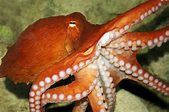
An octopus’s skin contains specialized cells called chromatophores, iridophores, and leucophores. Chromatophores are tiny sacs of pigment that can expand or contract in milliseconds, allowing the octopus to change color and pattern instantly.
The Biological Blueprint: Built Differently
Even more mind-blowing?
Their skin contains light-sensitive proteins called opsins, similar to those in our eyes. This means their skin can essentially “see” light and color patterns independent of their eyes, helping them match their surroundings perfectly.
Some species even have taste receptors in their suckers, so they’re literally tasting the ocean floor as they move.
· Movement Mastery: Forget bones. An octopus is a muscular hydrostat—its strength and movement come from muscles against fluid.
This allows it to become a streamlined rocket for jet propulsion, a flowing blanket to glide over reefs, or a rigid shape to wedge into a tiny crack.
Each of its 200+ suckers can move independently, grip with immense strength, and detect taste and texture.
A Brain Like No Other: Distributed Intelligence
Here’s where things get truly alien. An octopus has a central brain, but two-thirds of its neurons are located in its arms.
Each arm has a degree of independent processing power. An arm severed (and they can regrow them!) can still reach, grasp, and react to stimuli.
This “distributed intelligence” allows for incredible multi-tasking—an arm can be probing a den for food while others are manipulating a shell and another anchors the body.
Their central brain is a donut shape around their esophagus, and they are master problem-solvers, known for opening jars, escaping tanks, and using tools like coconut shells for shelter.
Metabolic Magic: The Ultimate Adaptable Eater
Octopuses are carnivorous predators with a high metabolic rate. They hunt crabs, fish, and shellfish. Their secret weapon is a venomous saliva, injected via a sharp beak, that paralyzes prey and begins breaking down its flesh for easier consumption.
Their metabolism can adjust to feast-or-famine conditions, supporting their fast growth and short, intense lifespans (often just 1-3 years).
The Octopus vs. The Human: A Study in Contrasts
Comparing ourselves to an octopus highlights the breathtaking diversity of life.
· Centralized vs. Distributed:
We have one central command center (our brain) sending orders to obedient limbs. An octopus has a command center and eight smart, semi-autonomous subsidiaries.
· Bone vs. Fluid:
We are rigid, strong, but limited by our skeleton. They are the ultimate shapeshifters, limited only by the size of their beak (the only hard part).
· Learning & Memory: We learn over a long lifetime, passing knowledge culturally. Octopuses are largely solitary and don’t teach their young, yet they display astonishing short- and long-term memory and individual personality, solving complex puzzles through sheer ingenuity.
· Connection to Environment: We interact with our world at a distance through focused senses. An octopus is intimately, chemically, and texturally connected to its surroundings through its skin and suckers.
Conclusion: Nature’s Independent Genius
The octopus is special because it represents an entirely different solution to the problems of life. It shows us that high intelligence, complex perception, and consciousness can arise in a form utterly foreign to our own. In its three hearts, we see resilience. In its blue blood, adaptation. In its seeing skin and thinking arms, a form of awareness we are only beginning to understand.
It is not a “higher” or “lower” creature. It is a masterpiece on a parallel path—a glorious reminder that on our blue planet, wonder wears many forms, and some of the most profound intelligence lurks in the deep, gazing back with a eye that is strikingly, hauntingly, familiar.